
US State of the Union 2026Key Insights for Australian Clients
- President Trump used the 2026 State of the Union to validate his first year in office and lock in a domestic policy agenda spanning trade, health care, technology and national security.
- For Australian clients, the immediate priority is tariffs — with a new 15% global levy already in effect — but the broader implications across defence, pharma, AI and investment are equally significant.
- This briefing draws out the key themes most relevant to Australian businesses and flags what to watch in the weeks ahead.
Tariffs – The Most Immediate Risk
This is the single most impactful issue for Australian businesses right now.
- On 24 February 2026 Trump enacted a 15% global import tariff that overrides the Australia-US Free Trade Agreement (AUSFTA). This followed a Supreme Court ruling that struck down his previous tariff regime.
- The SOTU confirmed that tariffs are not a short-term tactic — they are a permanent strategic lever for revenue, tax redistribution, and trade negotiation.
- Key Australian sectors affected: wine, steel & aluminium (50%), copper (50%), autos (25%), timber, wood products and furniture.
- Australian beef has been confirmed exempt from the new 15% tariff, following an agreement struck in November 2025 — a significant win for Australia’s largest red meat export market. Meat & Livestock Australia (MLA) and Cattle Australia have both confirmed the 0% tariff rate holds. However, sheepmeat and goatmeat are not so fortunate, facing an increase from 10% to 15%. MLA has said it will work with industry and government to address the impact on those sectors. Trade Minister Farrell, expected to visit Washington shortly, has flagged he will push for the removal of remaining tariffs — but for beef producers, the immediate risk has been averted.
- Estimated GDP impact: modest at 0.2–0.5%, but uncertainty is the real economic risk. Watch: Trade Minister Farrell has signalled Australia will “examine all options” — monitor for bilateral negotiations or WTO action.
The SOTU’s reference to “other authorities” post-Supreme Court ruling signals further tariff escalation remains on the table. Australian clients in trade-exposed sectors should be seeking legal and government affairs counsel now.
Watch: Trade Minister Farrell has signalled Australia will “examine all options” — monitor for bilateral negotiations or WTO action.
Foreign Policy & Alliance Dynamics – AUKUS in Focus
- Trump’s “peace through strength” framing and hard-power posture has direct implications for Australia’s strategic positioning.
- On Iran, Australia has already distanced itself from the 2025 US strikes, labelling them “unilateral.” Any escalation – which the SOTU signalled remains possible – could put AUKUS commitments and regional security under renewed pressure.
- On Ukraine, the US is routing support through NATO with “reimbursement language” – signalling allies must pay their way. This burden-sharingdoctrine extends to the Indo-Pacific.
Critically, the SOTU offered no explicit reassurances to regional allies like Australia, Japan or Taiwan – a notable omission given China’s posture in the Pacific.
Watch: Whether AUKUS timelines, nuclear submarine arrangements, and defence cost-sharing are revisited under this “allies must contribute” framework.
Health Care & Pharma – Sector Risk
- The SOTU proposed “most favoured nation” (MFN) drug pricing, which would force pharmaceutical manufacturers to match the lowest global price paid for their drugs.
- Australia’s Pharmaceutical Benefits Scheme (PBS) already operates as a price-reference market globally. This could draw direct US attention to Australian drug pricing as a negotiating flashpoint — as it did during the original AUSFTA negotiations.
- Australian pharma companies with US operations or supply chains should monitor implementation details closely.
Tech, AI & Data Centres – Opportunity Signal
- The “ratepayer protection pledge”requiring Big Tech to self-supply power for data centres may slow US data centre expansion, given existing grid bottlenecks.
- This reinforces Australia’s growing appeal as a data centre and AI infrastructure hub — stable environment, renewable energy potential, and proximity to Indo-Pacific growth markets.
Australia’s National AI Plan positions the country well to attract investment that faces friction in the US market.
Opportunity: Australian tech and infrastructure clients should watch for US Big Tech firms accelerating offshore data centre investment, particularly in Australia.
Housing & Financial Services
- The proposed executive action to restrict institutional investorsfrom buying single-family homes mirrors a debate already active in Australia around housing affordability and corporate landlords.
- If implemented, this could shift US institutional capital (private equity, REITs) toward alternative markets — including Australian residential and commercial real estate.
- Australian financial services and property sector clients should monitor US capital flows and any regulatory contagion effect.
Political Outlook – Midterms Context
- The SOTU was explicitly a midterm campaign launch. Trump’s framing of economic wins on inflation, jobs and borders is designed to rebuild credibility before November 2026.
- The Democratic counter-narrative (tariffs as a $1,700-per-family tax, rural hospital closures, immigration overreach) will intensify — creating an unpredictable legislative environment.
- Australian clients should expect continued policy volatility across tariffs, health care, and tech regulation as both parties compete for the November vote. Long-term planning should account for potential policy reversal post-midterms.
Summary – Priority Actions for Australian Clients
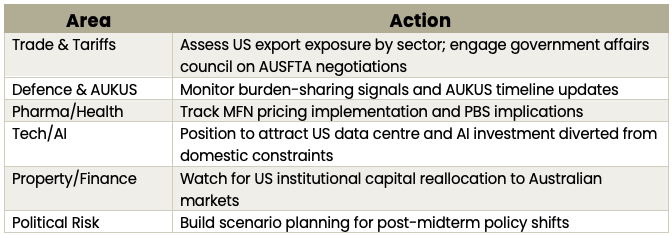
The overarching message for Australian clients: the US is in a period of deliberate, structural policy re-orientation — not temporary disruption. Businesses with US exposure need active monitoring strategies, not a “wait and see” approach.